Tuesday, July 07, 2009

Facing the Blue

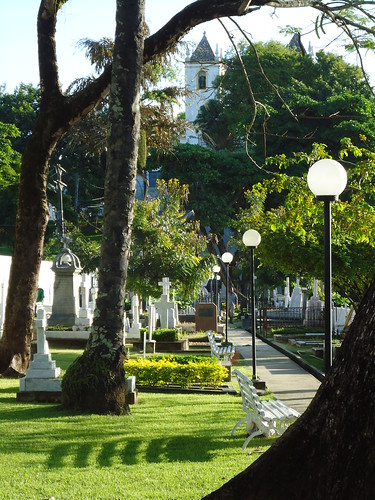
Reopened in February of last year, the British Cemetery on Ladeira da Barra has become an open-air museum with an ample view of the bay. Just ring the bell.

By Tatiana Mendonça

Translated by H. Sabrina Gledhill

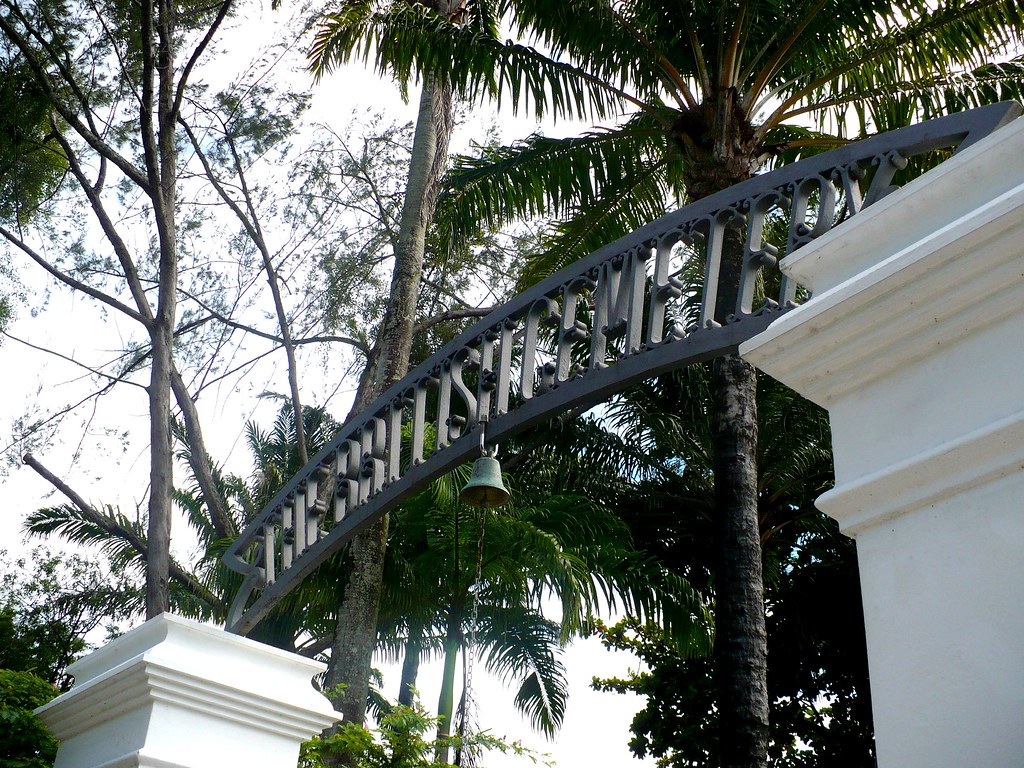
The expression goes “for the English to see.”* In this case, their dead have one of the best views of the bay. The fact that they can’t enjoy it is a mere detail. But anyone can share the peace and quiet that reigns supreme in the British Cemetery on Ladeira da Barra, with the added advantage of having eyes to see. All they have to do is ring the bell at the gate.

But it hasn’t always been this way. There was a time when the jungle had taken over this place and thieves jumped over the fragile wall to hide their loot. It was back then, in 2004, that Sabrina Gledhill, a British researcher, came across the cemetery. She was working in the chapel with children from the Ibeji NGO. The social project is no more, but her interest in this place persisted.

Sabrina took part in the development of a revitalization project that gained the support of FazCultura (the state tax incentive program for cultural projects) and the Clemente Mariani Foundation. And then there was light. In February of last year, the cemetery founded in 1811 was reopened in the presence of the British Ambassador in Brazil, Peter Collecott. The first stage of the project should be completed this year, but there is still a great deal of work to be done. Some tombstones are still in pieces, but visitors can already turn this spot into a sort of open-air museum. “Brazilians and Britons see cemeteries very differently. Here people think they are macabre. But for the British, they are places of peace, serenity and remembrance.”

The British Cemetery was created because, being Protestant, the Britons who arrived in Bahia could not be (and did not want to be) buried in churches, as was the custom among Catholics at the time.

DOCTORS AND SLAVE TRADERS

The cemetery is located in one of the finest parts of the city and is the resting place of some 500 people. “It is hard to say exactly how many, because many of the tombstones have disappeared,” says Sabrina. The records show that two sailors from the Beagle, which brought Darwin to Bahia, were buried there, but the researcher has not been able to find the spot. Nor has she found the grave of the Japanese sailor who committed seppuku aboard a British ship.

One of the tombs that is still in its original place is that of John Ligertwood Paterson, MD. A pioneer in the fight against cholera and yellow fever, he helped found the Isolation Hospital, now Couto Maia Hospital. He made a point of tending to the poor and enslaved. When he died, the people carried his coffin to the cemetery on their shoulders.

The first person buried in this place was John Sharp, a slave trader who died in 1813. His tomb lies in the shadow of a tree, the stone covered in moss.

But it isn’t just Britons who are buried here. A Bahian woman, Maria Constância Ogilvie, the wife of a British merchant, is also there. After she died, her husband returned to Europe to heal his sorrows. In the lower portion, there are Jews – British and of other nationalities – and many stones bear Hebrew inscriptions. Before the Israelite Cemetery was created, they went there to live life eternal.

The British Cemetery has not been deactivated, as many believe. Burials are still performed there – most recently that of Susan Wilkes, in 2007. Listed as a heritage site in the state of Bahia, the cemetery is maintained by the St. George’s Society, the NGO that represents the British community in this state. While the place was being restored, they had to ask the permission of the IBAMA (the environmental protection agency) to remove a tree that was growing between two tombs. Life and its cycles. One inscription reads “Life is Eternal.” In a way, it is true.

*(Translator’s note: A Brazilian expression meaning “whitewash” or “sham” – the author is using it literally in this case.)


Article published in Muito magazine by the A Tarde newspaper on 5th July 2009

Tuesday, February 24, 2009

Darwin in Bahia programme launch
Darwin Launch/Lançamento

Click on image to see slide show
Held at the British Cemetery on February 12, 2009

Saturday, November 22, 2008

Obituary of Commander Fead (1809-1853)


Texto não disponível

The Gentleman's Magazine

From Rededication of the British Cemetery

Friday, November 21, 2008

Edward Pellew Wilson's tomb

Edward Pellew Wilson tomb

Tuesday, November 18, 2008

The Chapel

Photo by Richard Vignoles

The British Cemetery Chapel, seen from the Yacht Club

Saturday, October 18, 2008

Symposium on British Presence in Bahia


INTERNATIONAL SYMPOSIUM ON DIPLOMACY, ECONOMICS AND CULTURE: THE HISTORY OF THE BRITISH PRESENCE IN BAHIA - 3rd to 8th November 2008

This cultural event is being promoted by the St. George’s Society and has the support and approval of the British Embassy, is in receipt of funding from FAPESB and is being hosted by the Centro de Memória da Bahia, Fundação Pedro Calmon from 3 to 7 November.

Participation is free of charge; however, places are limited. If you are interested in participating, please contact Sabrina Gledhill at britanicosnabahia@gmail.com to reserve your place.

From 3 to 7 Nov, the programme will be in Portuguese at the auditorium of the Central Library in Barris. On the 8th, a special event will be held at the British Cemetery Chapel, where the presentations that were translated during the main event will be given once again in English, without translation:
Marc Herold - "The British Contribution to Bahia"
Louise Guenther - "The British Merchant Community in Bahia in the 19th century"
John Vignoles - "Charles Blacker Vignoles and Hutton Vignoles: The British engineers who built the Bahia and São Francisco Railway"

For further information on the Symposium (in Portuguese) visit britanicosnabahia.blogspot.com


Thursday, June 12, 2008

Brazilian Supreme Court rules in favour of British Cemetery

British Cemetery and Yacht Club

On May 21st, the Brazilian Supreme Court ruled that cemeteries that are extensions of religious entities, operate on a non-profit basis and are exclusively devoted to religious and funerary services are exempt from property tax (IPTU).

This decision was reached unanimously when judging an appeal lodged by the St. George's Church and British Cemetery Society of Salvador, Bahia, and the Anglican Church, contesting the decision of the Bahian Court, which did not recognise that the area where the cemetery is located is exempt from property tax. The Bahian treasury was threatening to auction off the historic cemetery to pay off a debt of BRL 41,831.70 (over 10,000 pounds) for the period between 1994 and 1996.

Heritage site
Situated in one of the finest districts of Salvador, Bahia (Ladeira da Barra), the Anglican chapel and cemetery were built 200 years ago by Britons who accompanied the Portuguese royal family when they arrived in Brazil in 1808.
According to the defence, the future King João VI of Portugal signed the free navigation treaty with the British goverment in the chapel (demolished in the 1970s), thereby ensuring that Anglican British subjects resident in Salvador had the right to worship and bury their dead.
The cemetery has been listed as a heritage site at the state level and is in the process of being listed at the federal level by the Ministry of Culture's National Institute for Historic and Artistic Heritage.

For more background information click here


The British Church and Cemetery at Salvador are owned and administered by the "SOCIEDADE DA IGREJA DE SÃO JORGE E CEMITERIO BRITANICO" (a non-profit organisation), representing the British community in Bahia.